
If you are above 60, you'll surely recognise these two brilliant performers. If you are not, you're in for a pleasant surprise. Listen to this fun-filled rendition of When the Saints Go Marching In. Great Entertainment by Danny Kaye and Louis Armstrong from the 1959 film The Five Pennies.

Rhoda's Blog. Connecting with people. Since 2005.
Showing posts with label people. Show all posts
Showing posts with label people. Show all posts
November 17, 2015


January 13, 2015
Nightmare in Nigeria
Last week, hundreds were killed by Boko Haram militants in the town of Baga in the north-eastern state of Borno in Nigeria. Some reports say that it is one of this terror group’s worst massacres to date and that local authorities have given up counting the bodies left lying on the streets. The Nigerian government is supposedly downplaying the attack and the number of casualties. For a recent report in the Guardian, Click Here.
This was happening in Nigeria at the same time as the terrorist attacks in Paris. Yet, the lack of media coverage and the world's reaction to the Nigerian nightmare has been quite muted. Some are questioning why 12 killings in Paris are more condemnable than 1200 Africans killed in Nigeria. What makes one massacre more newsworthy than another?

The placard says:
I AM CHARLIE.
Let's not forget the victims of Boko Haram"
Click Here for a report from The Guardian and Here for the BBC report of the recent slaughter in Nigeria, as Boko Haram continues its attacks with impunity.
January 09, 2015
Charlie Hebdo
Immediately after the murders at the humor magazine Charlie Hebdo's offices in Paris, The Patheos carried James Ford's Small Rant Against Religious Fundamentalism. Click Here to read it and Click Here for some heartbreaking cartoons from around the world.
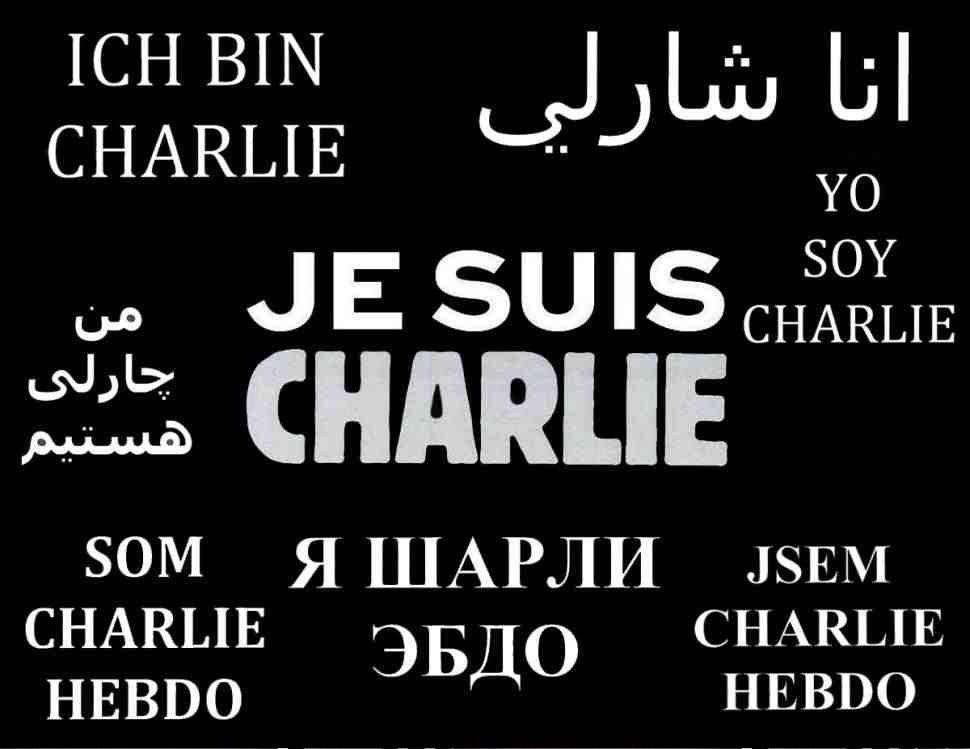
Within days, two more related violent episodes- Hostages and Police Raids - have occurred in Paris. Meanwhile, the media coverage and discussions continue. Tens of thousands are tweeting their solidarity under the tag #JeSuisCharlie in many languages. Another tag #JesuisAhmed has emerged, to honor the French Muslim cop who was shot dead by the terrorists escaping after the massacre inside the Hebdo office.
On Sunday, there was a nationwide outpouring of grief, solidarity and defiance as people of all ages, religions and nationalities marched along a three-kilometer route en masse to show their respect for the victims and support for the values of the French Republic: “liberté, égalité, fraternité”. It was the first time since the liberation of Paris in August 1944 that so many people - an estimated 3.7 million - took to the streets of the city. Heads of state of several countries were on the front line, right behind the families of the victims. Leaders of all the religions marched behind a banner bearing the slogan “We are Charlie”.
Violence in the name of religion is as old as organised religion itself. What will be the repercussions of this week's attacks? When something terrible happens, first we run for shelter. Next we re-emerge and seek each other for support.Then comes the urge to go out there to reclaim and protect what belongs to you. Will The Western countries seriously re-consider their national policies regarding radical Islam and immigration laws?
France has the largest Muslim population - about 5 million - in Europe. No doubt the vast majority of them strongly condemn the massacre; but many find it difficult to identify with Charlie Hebdo who *ridiculed* the Prophet of Islam. There is already a reaction: "Je ne suis pas Charlie" (I am not Charlie). Which direction will their process of assimilation and integration take? Issues of allegiance and loyalty are both visceral and controversial.
The first issue of Charlie Hebdo after last week's terrorist killings in their office is out. It sends out a call to forgive the murderers and at the same time, carries a controversial cover. One European head of goernment commented on the latter: "You may not agree with what they have done, you may be offended by what they have done, but you should defend their right to publish it.” Pope Francis, when asked for his view, said that freedom of speech was a fundamental human right but it came with an obligation. “every religion has its dignity. One cannot provoke, one cannot insult other people’s faith, one cannot make fun of faith.”.
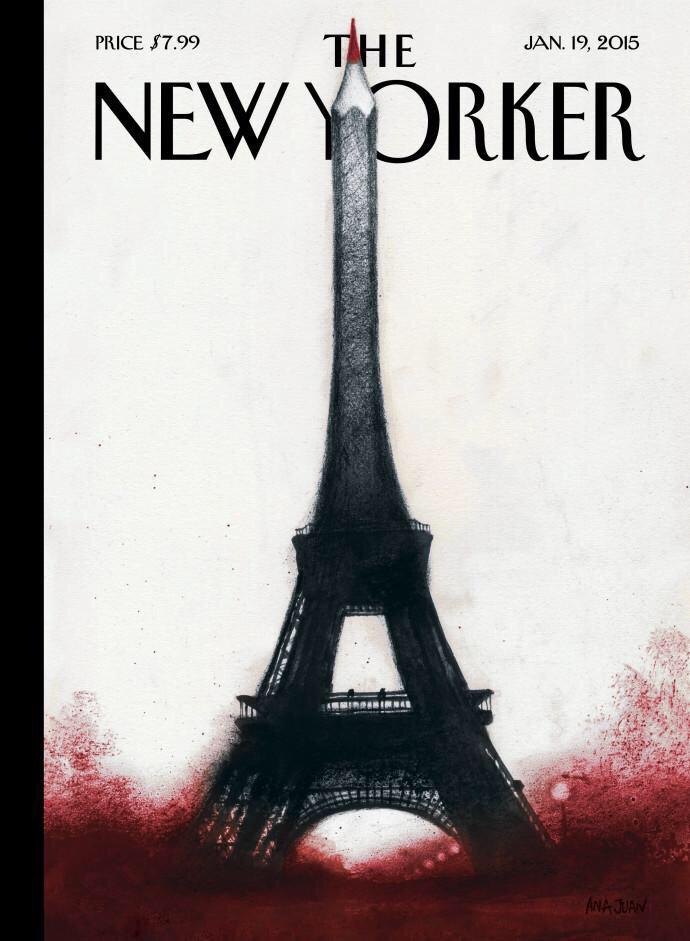
This cover of the New Yorker is priceless.
Within days, two more related violent episodes- Hostages and Police Raids - have occurred in Paris. Meanwhile, the media coverage and discussions continue. Tens of thousands are tweeting their solidarity under the tag #JeSuisCharlie in many languages. Another tag #JesuisAhmed has emerged, to honor the French Muslim cop who was shot dead by the terrorists escaping after the massacre inside the Hebdo office.
On Sunday, there was a nationwide outpouring of grief, solidarity and defiance as people of all ages, religions and nationalities marched along a three-kilometer route en masse to show their respect for the victims and support for the values of the French Republic: “liberté, égalité, fraternité”. It was the first time since the liberation of Paris in August 1944 that so many people - an estimated 3.7 million - took to the streets of the city. Heads of state of several countries were on the front line, right behind the families of the victims. Leaders of all the religions marched behind a banner bearing the slogan “We are Charlie”.
Violence in the name of religion is as old as organised religion itself. What will be the repercussions of this week's attacks? When something terrible happens, first we run for shelter. Next we re-emerge and seek each other for support.Then comes the urge to go out there to reclaim and protect what belongs to you. Will The Western countries seriously re-consider their national policies regarding radical Islam and immigration laws?
France has the largest Muslim population - about 5 million - in Europe. No doubt the vast majority of them strongly condemn the massacre; but many find it difficult to identify with Charlie Hebdo who *ridiculed* the Prophet of Islam. There is already a reaction: "Je ne suis pas Charlie" (I am not Charlie). Which direction will their process of assimilation and integration take? Issues of allegiance and loyalty are both visceral and controversial.
The first issue of Charlie Hebdo after last week's terrorist killings in their office is out. It sends out a call to forgive the murderers and at the same time, carries a controversial cover. One European head of goernment commented on the latter: "You may not agree with what they have done, you may be offended by what they have done, but you should defend their right to publish it.” Pope Francis, when asked for his view, said that freedom of speech was a fundamental human right but it came with an obligation. “every religion has its dignity. One cannot provoke, one cannot insult other people’s faith, one cannot make fun of faith.”.
May 31, 2014
Memorable Quotes of Maya Angelou
Yesterday I posted my Tribute to Maya Angelou. If you have never read her before, here is your chance. I picked these 25 quotes from the Latin Times, to celebrate her life and lasting legacy:
- “I've learned that people will forget what you said, people will forget what you did, but people will never forget how you made them feel.” -- Maya Angelou
- “My great hope is to laugh as much as I cry; to get my work done and try to love somebody and have the courage to accept the love in return.” -- Maya Angelou
- “My mother said I must always be intolerant of ignorance but understanding of illiteracy. That some people, unable to go to school, were more educated and more intelligent than college professors.” -- Maya Angelou
- “While I know myself as a creation of God, I am also obligated to realize and remember that everyone else and everything else are also God's creation.” -- Maya Angelou
- “Music was my refuge. I could crawl into the space between the notes and curl my back to loneliness.” -- Maya Angelou
- “Love recognizes no barriers. It jumps hurdles, leaps fences, penetrates walls to arrive at its destination full of hope.” -- Maya Angelou
- “Courage is the most important of all the virtues, because without courage you can't practice any other virtue consistently. You can practice any virtue erratically, but nothing consistently without courage.” -- Maya Angelou
- “Prejudice is a burden that confuses the past, threatens the future and renders the present inaccessible.” -- Maya Angelou
- “It is time for parents to teach young people early on that in diversity there is beauty and there is strength.” -- Maya Angelou
- “You can't forgive without loving. And I don't mean sentimentality. I don't mean mush. I mean having enough courage to stand up and say, 'I forgive. I'm finished with it.'” -- Maya Angelou
- “When someone shows you who they are, believe them the first time.” -- Maya Angelou
- “Words mean more than what is set down on paper. It takes the human voice to infuse them with deeper meaning.” -- Maya Angelou
- “There is no greater agony than bearing an untold story inside you.” -- Maya Angelou
- “All great achievements require time.” -- Maya Angelou
- “I've learned that you shouldn't go through life with a catcher's mitt on both hands; you need to be able to throw something back.” -- Maya Angelou
- “We may encounter many defeats but we must not be defeated.” -- Maya Angelou
- “Any book that helps a child to form a habit of reading, to make reading one of his deep and continuing needs, is good for him.” -- Maya Angelou
- “Bitterness is like cancer. It eats upon the host. But anger is like fire. It burns it all clean.” -- Maya Angelou
- “I'm grateful to intelligent people. That doesn't mean educated. That doesn't mean intellectual. I mean really intelligent. What black old people used to call 'mother wit' means intelligence that you had in your mother's womb. That's what you rely on. You know what's right to do.” -- Maya Angelou
- “You are the sum total of everything you've ever seen, heard, eaten, smelled, been told, forgot - it's all there. Everything influences each of us, and because of that I try to make sure that my experiences are positive.” -- Maya Angelou
- “One isn't necessarily born with courage, but one is born with potential. Without courage, we cannot practice any other virtue with consistency. We can't be kind, true, merciful, generous, or honest.” -- Maya Angelou
- “A wise woman wishes to be no one's enemy; a wise woman refuses to be any one's victim.” -- Maya Angelou
- “If you don't like something, change it. If you can't change it, change your attitude. Don't complain.” -- Maya Angelou
- “I'm convinced of this: Good done anywhere is good done everywhere. For a change, start by speaking to people rather than walking by them like they're stones that don't matter. As long as you're breathing, it's never too late to do some good.” -- Maya Angelou
- “What is a fear of living? It's being preeminently afraid of dying. It is not doing what you came here to do, out of timidity and spinelessness. The antidote is to take full responsibility for yourself - for the time you take up and the space you occupy. If you don't know what you're here to do, then just do some good.” -- Maya Angelou
May 29, 2014
Maya Angelou
She's gone. One of my all time favourite women. 86 years of dynamite. Maya Angelou is among the most celebrated and influential women of recent times. In farewell, it seems appropriate to quote her own words:
No matter what she undertook, she became a trailblazer. Author, poet, historian, songwriter, playwright, dancer, stage and screen producer, director, performer, singer, and civil rights activist. Her biography The Global Renaissance Woman ends thus: "Dr. Angelou’s words and actions continue to stir our souls, energize our bodies, liberate our minds, and heal our hearts."
When I think of death, and of late the idea has come with alarming frequency, I seem at peace with the idea that a day will dawn when I will no longer be among those living in this valley of strange humors.
I can accept the idea of my own demise, but I am unable to accept the death of anyone else.
I find it impossible to let a friend or relative go into that country of no return.
Disbelief becomes my close companion, and anger follows in its wake.
I answer the heroic question 'Death, where is thy sting? ' with ' it is here in my heart and mind and memories.'
I can accept the idea of my own demise, but I am unable to accept the death of anyone else.
I find it impossible to let a friend or relative go into that country of no return.
Disbelief becomes my close companion, and anger follows in its wake.
I answer the heroic question 'Death, where is thy sting? ' with ' it is here in my heart and mind and memories.'
 |
| Maya Angelou in 1970 |
"A bird doesn't sing because it has an answer. It sings because it has a song."
Her voice and her words have resonated in the US and globally. Raised in the deep South she imbibed and retained strong African American values. A champion of civil rights, she was closely associated with Martin Luther King Jr and Malcolm X. In the seventies her book I Know Why the Caged Bird Sings made her famous. In her lifetime she has published 30 best-selling titles of poetry, fiction and non-fiction. Combined with a flair for poetry and a passion for the performing arts, she was internationally acclaimed.No matter what she undertook, she became a trailblazer. Author, poet, historian, songwriter, playwright, dancer, stage and screen producer, director, performer, singer, and civil rights activist. Her biography The Global Renaissance Woman ends thus: "Dr. Angelou’s words and actions continue to stir our souls, energize our bodies, liberate our minds, and heal our hearts."
January 31, 2014
Amazing Nick Vuicic
NO ARMS, NO LEGS.
No Worries!
This is what Nick Vuicic believes. The absence of arms and legs has not deterred him from living life the way he wants to. Above all, he is an extraordinary human being with a zest for life and a strong belief in the power of faith and a positive attitude.A wonderful motivational speaker, he has visited 24 countries and addressed 3 million people. He's a big hit with teenagers. Watch Five Minutes with Nick Vuicic and you too will be amazed.
 |
| Nick Vuicic in India |
He was born in Australia with a rare condition - a perfectly healthy baby without any limbs. His parents gradually came to terms with it and decided to give him a normal upbringing. Nick attended mainstream schools and acquired a university degree. While a student he founded Life Without Limbs, a non-profit organisation which he continues to mentor.
None of this happened without grit and hard work. As a 10-year-old, Nick was so depressed and frustrated that he had seriously considered suicide. There were ups and downs. Today, thirty one year-old Nick Vuicic owns a company called Attitude is Altitude. He has written books and acted in films. He enjoys swimming, surfboarding, football and golf. He has even gone skydiving! Hard to believe? Read this article in the Daily Mail -UK.
 |
| Nick, Kanae and Kiyosho |
Something very special happened in 2012. Nick Vuicic fell in love and married Kanae Miyahara. How did he slip the ring on her finger? That is another heart-warming story! Now they live in California with their little son Kiyosho. Nick continues to work and travel, carrying his inspirational message: No arms, No legs. No Worries!
January 04, 2014
Pope Francis
Pope Francis I is the TIME magazine's Person of the year 2013. Never mind what I think of the choice. The question is: What do you think about it? Before jumping to conclusions, we need some background information.
 He is Jorge Mario Bergoglio, a 76-year-old Argentinian. Son of an Italian immigrant, young Jorge trained as a chemical technician before joining the Jesuit priesthood. He was the Archbishop of Buenos Aires till his election as pope in March 2013, succeeding Pope Benedict who resigned, due to old age and ill health. The first non-European pope in 1,200 years, he is poised to transform a place that measures change by the century.
The changes began with the new name that he chose. Of the 266 popes in history, 23 were named John. He is the first in 2000 years to choose the name Francis - after Francis of Assisi, the 13th century saint who gave up luxury to follow a radical Christ-like life and is revered as the patron of the poor. He took this name and promptly called for a church of healing.
 Social justice has always been a strong plank in his life's work in Argentina. He retains the same focus on social doctrine, together with the traditional priestly role of upholding faith and morals. The Latin motto on his Coat of Arms means: "Having mercy and choosing him", a reference to the apostle Mathew, a lowly tax collector, whom Jesus called to be one of His twelve disciples.
"... what makes this Pope so important is the speed with which he has captured the imaginations of millions who had given up on hoping for the church at all.".
People are weary of the many problems besetting the Roman Catholic Church, when all the while (to borrow from Milton), “the hungry Sheep look up, and are not fed.” In a matter of months, Pope Francis has elevated the healing mission of the Church — the church as servant and comforter of hurting people in an often harsh world — above the doctrinal work which has always been paramount to its leaders.
"... the new Pope may have found a way out of the 20th century culture wars, which have left the church moribund in much of Western Europe and on the defensive from Dublin to Los Angeles."
Not everybody agrees with the selection of TIME magazine. More about this in another post. Meanwhile:
Do you know how he celebrated his first birthday as Pope? Click Here.
Have you seen his most popular pictures after becoming Pope? Click here.
Selection
Time's Top 5 Finalists for 2013. Now read the Lead Article on Pope Francis. It is a longish article, so in this post I have paraphrased a few extracts.Who is Pope Francis?
 He is Jorge Mario Bergoglio, a 76-year-old Argentinian. Son of an Italian immigrant, young Jorge trained as a chemical technician before joining the Jesuit priesthood. He was the Archbishop of Buenos Aires till his election as pope in March 2013, succeeding Pope Benedict who resigned, due to old age and ill health. The first non-European pope in 1,200 years, he is poised to transform a place that measures change by the century.
The changes began with the new name that he chose. Of the 266 popes in history, 23 were named John. He is the first in 2000 years to choose the name Francis - after Francis of Assisi, the 13th century saint who gave up luxury to follow a radical Christ-like life and is revered as the patron of the poor. He took this name and promptly called for a church of healing.

Why the World Notices
Quite apart from the fact that he is the spiritual head of a huge Global Catholic Population, Pope Francis I comes across as unique. And not simply because of his headline-grabbing pictures of being a caring pastor. He has formally stated:
I prefer a Church which is bruised, hurting and dirty because it has been out on the streets, rather than a Church which is unhealthy from being confined and from clinging to its own security.
He has made it clear that it is not just talk. He wants actual transformation. Among the bishops and priests who run Catholic institutions. On the focus of activities. In the church finances. Soon after he was elected, he named a special commission to investigate the Vatican Bank which has been under a cloud since 2010. In turn they asked an independent firm for an audit. In October, the bank disclosed an annual report for the first time in its 125-year history.
The following quotes highlight the reason why he captured world attention in 2013:
I prefer a Church which is bruised, hurting and dirty because it has been out on the streets, rather than a Church which is unhealthy from being confined and from clinging to its own security.
The following quotes highlight the reason why he captured world attention in 2013:
"... what makes this Pope so important is the speed with which he has captured the imaginations of millions who had given up on hoping for the church at all.".
People are weary of the many problems besetting the Roman Catholic Church, when all the while (to borrow from Milton), “the hungry Sheep look up, and are not fed.” In a matter of months, Pope Francis has elevated the healing mission of the Church — the church as servant and comforter of hurting people in an often harsh world — above the doctrinal work which has always been paramount to its leaders.
"... the new Pope may have found a way out of the 20th century culture wars, which have left the church moribund in much of Western Europe and on the defensive from Dublin to Los Angeles."
Not everybody agrees with the selection of TIME magazine. More about this in another post. Meanwhile:
Do you know how he celebrated his first birthday as Pope? Click Here.
Have you seen his most popular pictures after becoming Pope? Click here.
May 30, 2013
Classic Indianisms
We Indians have made the English language our own, adding colourful words and colloquial phrases literally translated from our regional languages. The following (author unknown) describes ten classic Indianisms.
Take greetings for example. A friendly clerk asking me for my name is apt to start a conversation with, What is your good name? As if I hold that sort of information close to my heart and only divulge my evil pseudonym. Bizarre.
1. 'Passing out'
When you complete your studies at an educational institution, you graduate from that institution.
You do not "pass out" from that institution.
To "pass out" refers to losing consciousness, like after you get too drunk, though I'm not sure how we managed to connect graduating and intoxication. Oh wait of course, poor grades throughout the year could lead to a sudden elation on hearing you've passed all of your exams, which could lead to you actually "passing out," but this is rare at best.
2. 'Kindly revert'
One common mistake we make is using the word revert to mean reply or respond.
Revert means "to return to a former state."
I can't help thinking of a sarcastic answer every time this comes up: Please revert at the earliest.
Sure, I'll set my biological clock to regress evolutionarily to my original primitive hydrocarbon state at 1 p.m. today."
3. 'Years back'
If it happened in the past, it happened years ago, not "years back."
Given how common this phrase is, I'm guessing the first person who switched "ago" for "back" probably did it years back. See what I mean?
And speaking of "back," asking someone to use the backside entrance sounds so wrong.
So when did you buy this car?
Oh, years back.
Cool, can you open the backside? I'd like to get a load in.
4. 'Doing the needful'
Try to avoid using the phrase "do the needful." It went out of style decades ago, about the time the British left. Using it today indicates you are a dinosaur, a dinosaur with bad grammar.
You may use the phrase humorously, to poke fun at such archaic speech or other dinosaurs.
Will you do the needful?
Of course, and I'll send you a telegram to let you know it's done too.
5. 'Discuss about'
What shall we discuss about today?
Let's discuss about politics. We need a fault-ridden topic to mirror our bad grammar.
You don't "discuss about" something; you just discuss things.
The word "discuss" means to "talk about". There is no reason to insert the word "about" after "discuss."
That would be like saying "talk about about." Which "brings about" me to my next peeve.
6. 'Order for'
"Hey, let's order for a pizza." "Sure, and why not raid a library while we're about it.
When you order something, you "order" it, you do not "order for" it.
Who knows when or why we began placing random prepositions after verbs? Perhaps, somewhere in our history someone lost a little faith in the "doing" word and added "for" to make sure their order would reach them. They must have been pretty hungry.
7. 'Do one thing'
"Do one thing ... take this piece of chalk ..."
When someone approaches you with a query, and your reply begins with the phrase "do one thing," you're doing it wrong.
"Do one thing" is a phrase that does not make sense. It is an Indianism. It is only understood in India. It is not proper English. It is irritating.
There are better ways to begin a reply. And worst of all, any person who starts a sentence with "do one thing" invariably ends up giving you at least five things to do.
My computer keeps getting hung.
Do one thing. Clear your history. Delete your cookies. Defrag your hardrive. Run a virus check. Restart your computer...
8. 'Out of station'
Sorry I can't talk right now, I'm out of station.
What a coincidence, Vijay, I'm in a station right now.
Another blast from the past, this one, and also, extremely outdated. What's wrong with "out of town" or "not in Mumbai" or my favorite "I'm not here"?
9. The big sleep
"I'm going to bed now, sleep is coming."
"OK, say hi to it for me."
While a fan of anthropomorphism, I do have my limits. "Sleep is coming" is taking things a bit too far. Your life isn't a poem. You don't have to give body cycles their own personalities.
10. 'Prepone'
Let's prepone the meeting from 11 a.m. to 10 a.m.
Because the opposite of postpone just has to be prepone, right?
"Prepone" is probably the most famous Indianism of all time; one that I'm proud of, and that I actually support as a new entry to all English dictionaries. Because it makes sense. Because it fills a gap. Because we need it.We're Indians, damn it. Students of chaos theory.
We don't have the time to say silly things like "could you please bring the meeting forward." Prepone it is.
There are many more pure grammatical "gems" in what we call Indian English. Perhaps in time I'll list some more. And perhaps in the near future, we'll get better at English.
Till then, kindly adjust.
Grammatically insane phrases found in common Indian English
Take greetings for example. A friendly clerk asking me for my name is apt to start a conversation with, What is your good name? As if I hold that sort of information close to my heart and only divulge my evil pseudonym. Bizarre.
1. 'Passing out'
When you complete your studies at an educational institution, you graduate from that institution.
You do not "pass out" from that institution.
To "pass out" refers to losing consciousness, like after you get too drunk, though I'm not sure how we managed to connect graduating and intoxication. Oh wait of course, poor grades throughout the year could lead to a sudden elation on hearing you've passed all of your exams, which could lead to you actually "passing out," but this is rare at best.
2. 'Kindly revert'
One common mistake we make is using the word revert to mean reply or respond.
Revert means "to return to a former state."
I can't help thinking of a sarcastic answer every time this comes up: Please revert at the earliest.
Sure, I'll set my biological clock to regress evolutionarily to my original primitive hydrocarbon state at 1 p.m. today."
3. 'Years back'
If it happened in the past, it happened years ago, not "years back."
Given how common this phrase is, I'm guessing the first person who switched "ago" for "back" probably did it years back. See what I mean?
And speaking of "back," asking someone to use the backside entrance sounds so wrong.
So when did you buy this car?
Oh, years back.
Cool, can you open the backside? I'd like to get a load in.
4. 'Doing the needful'
Try to avoid using the phrase "do the needful." It went out of style decades ago, about the time the British left. Using it today indicates you are a dinosaur, a dinosaur with bad grammar.
You may use the phrase humorously, to poke fun at such archaic speech or other dinosaurs.
Will you do the needful?
Of course, and I'll send you a telegram to let you know it's done too.
5. 'Discuss about'
What shall we discuss about today?
Let's discuss about politics. We need a fault-ridden topic to mirror our bad grammar.
You don't "discuss about" something; you just discuss things.
The word "discuss" means to "talk about". There is no reason to insert the word "about" after "discuss."
That would be like saying "talk about about." Which "brings about" me to my next peeve.
6. 'Order for'
"Hey, let's order for a pizza." "Sure, and why not raid a library while we're about it.
When you order something, you "order" it, you do not "order for" it.
Who knows when or why we began placing random prepositions after verbs? Perhaps, somewhere in our history someone lost a little faith in the "doing" word and added "for" to make sure their order would reach them. They must have been pretty hungry.
7. 'Do one thing'
"Do one thing ... take this piece of chalk ..."
When someone approaches you with a query, and your reply begins with the phrase "do one thing," you're doing it wrong.
"Do one thing" is a phrase that does not make sense. It is an Indianism. It is only understood in India. It is not proper English. It is irritating.
There are better ways to begin a reply. And worst of all, any person who starts a sentence with "do one thing" invariably ends up giving you at least five things to do.
My computer keeps getting hung.
Do one thing. Clear your history. Delete your cookies. Defrag your hardrive. Run a virus check. Restart your computer...
8. 'Out of station'
Sorry I can't talk right now, I'm out of station.
What a coincidence, Vijay, I'm in a station right now.
Another blast from the past, this one, and also, extremely outdated. What's wrong with "out of town" or "not in Mumbai" or my favorite "I'm not here"?
9. The big sleep
"I'm going to bed now, sleep is coming."
"OK, say hi to it for me."
While a fan of anthropomorphism, I do have my limits. "Sleep is coming" is taking things a bit too far. Your life isn't a poem. You don't have to give body cycles their own personalities.
10. 'Prepone'
Let's prepone the meeting from 11 a.m. to 10 a.m.
Because the opposite of postpone just has to be prepone, right?
"Prepone" is probably the most famous Indianism of all time; one that I'm proud of, and that I actually support as a new entry to all English dictionaries. Because it makes sense. Because it fills a gap. Because we need it.We're Indians, damn it. Students of chaos theory.
We don't have the time to say silly things like "could you please bring the meeting forward." Prepone it is.
There are many more pure grammatical "gems" in what we call Indian English. Perhaps in time I'll list some more. And perhaps in the near future, we'll get better at English.
Till then, kindly adjust.
March 27, 2013
Easter, 2013
Easter is a festival of Renewal, Hope and Joy ... a celebration of the Triumph of Good over Evil. In the preceding 40 days, Christians are expected to prepare for the Resurrection of Jesus through penance, fasting, prayer and meditation.
I was reflecting on the basic paradox ... the weaknesses and frailties inherent in every human being and the exhortations to aspire for superhuman Christ-like perfection ... Then I came across this:
I was reflecting on the basic paradox ... the weaknesses and frailties inherent in every human being and the exhortations to aspire for superhuman Christ-like perfection ... Then I came across this:
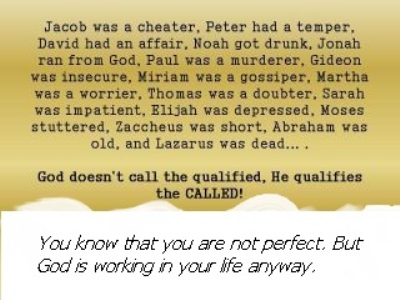
The Biblical prophets and saints apparently had serious shortcomings. Yet they became powerful instruments in the Divine Hand, performing extraordinary deeds and achieving great holiness.
With faith, one can overcome. For me, this is the message of Easter.

June 22, 2012
Indians in the US
Almost everyone I know has relatives and friends in the US. In India we call them NRIs... Non-Resident Indians. Their official label is PIO (Person of Indian Origin). We're proud of them.
Many of the first-generation NRIs are educated, talented young men and women who went to the US for higher studies and better jobs. Is it surprising that the drive to make good has led to hard work, perseverance and success? Read about their comparative performance here: Indian Americans Top in Income and Education.
Strong family ties and success stories beckoned more Indians to join the successful early migrants to the US. The IT industry did the rest. Today there are about 3 million NRIs in the US, the five most populated states being California, New York, New Jersey, Texas and Illinois. No prizes if you guessed that the largest single NRI concentration is in and around San Jose, the capital of Silicon Valley! You will find here some interesting information on NRIs.
The second and third generation NRIs are sometimes laughingly called ABCDs. More about this later...
Many of the first-generation NRIs are educated, talented young men and women who went to the US for higher studies and better jobs. Is it surprising that the drive to make good has led to hard work, perseverance and success? Read about their comparative performance here: Indian Americans Top in Income and Education.
Strong family ties and success stories beckoned more Indians to join the successful early migrants to the US. The IT industry did the rest. Today there are about 3 million NRIs in the US, the five most populated states being California, New York, New Jersey, Texas and Illinois. No prizes if you guessed that the largest single NRI concentration is in and around San Jose, the capital of Silicon Valley! You will find here some interesting information on NRIs.
The second and third generation NRIs are sometimes laughingly called ABCDs. More about this later...
December 14, 2011
Gift Shop at the South Pole

 |
| Amundsen, 1911 |
Fourteen million square miles of ice covers the entire continent. There's a lot more to know about the Antarctic Ice Sheet. Go to this link if you are interested in the connection between the Antarctic and global warming.
The coldest temperature on earth -128.6°F (-89.2°C) was recorded on this remote, permanently frozen continent. For more than 50 years the US and other countries are maintaining permanent stations around the South Pole. They comprise teams of scientists as well as a support staff of cooks, cargo handlers and construction crews.

To commemorate the centenary, about 300 visitors are expected at the South Pole over the course of the short Summer season of December and January, when temperatures hover around - 30 Fahrenheit. Some will ski from the continent’s edge while others will fly in, probably from New Zealand.
Learn more from the Gift Shop at the South Pole.
December 07, 2011
Mother Teresa - Anyway

People say that these words were written on the wall of Mother Teresa's Home in Calcutta, India. In popular belief world-wide, they are attributed to her. And they do seem to reflect her philosophy of life.
In 1968 Kent M Keith wrote a composition called "The Paradoxical Commandments" which was, apparently, modified and adopted by the Missionaries of Charity.
In 1968 Kent M Keith wrote a composition called "The Paradoxical Commandments" which was, apparently, modified and adopted by the Missionaries of Charity.
December 06, 2011
Andy Rooney
Over the years, I have come across and appreciated Andy Rooney's quotes from random sources. Initially, I had no idea who he was. Later I came to know that he was an American broadcaster. His weekly appearance on CBS made "60 Minutes" a very popular TV show. Millions watched and listened to his homespun wisdom and peeves which he aired week after week, from the seventies till now. In October 2011, a few days after his final broadcast at the age of 92, Andy Rooney Died in New York.
Some of Rooney's Famous One-liners
Some of Rooney's Famous One-liners
- I've learned....That the best classroom in the world is at the feet of an elderly person.
- I've learned.... That when you're in love, it shows.
- I've learned.... That just one person saying to me, 'You've made my day!' makes my day.
- I've learned....That having a child fall asleep in your arms is one of the most peaceful feelings in the world.
- I've learned.... That being kind is more important than being right.
- I've learned....That you should never say no to a gift from a child.
- I've learned.... That I can always pray for someone when I don't have the strength to help him in some other way.
- I've learned.... That no matter how serious your life requires you to be, everyone needs a friend to act goofy with.
- I've learned.... That sometimes all a person needs is a hand to hold and a heart to understand.
- I've learned.... That simple walks with my father around the block on summer nights when I was a child did wonders for me as an adult.
- I've learned.... That life is like a roll of toilet paper. The closer it gets to the end, the faster it goes.
- I've learned.... That we should be glad God doesn't give us everything we ask for.
- I've learned.... That money doesn't buy class.
- I've learned.... That it's those small daily happenings that make life so spectacular.
- I've learned.... That under everyone's hard shell is someone who wants to be appreciated and loved.
- I've learned.... That to ignore the facts does not change the facts.
- I 've learned.... That when you plan to get even with someone, you are only letting that person continue to hurt you.
- I've learned.... That love, not time, heals all wounds.
- I've learned.... That the easiest way for me to grow as a person is to surround myself with people smarter than I am.
- I've learned.... That everyone you meet deserves to be greeted with a smile..
- I've learned.... That no one is perfect until you fall in love with them.
- I've learned... That life is tough, but I'm tougher.
- I've learned.... That opportunities are never lost; someone will take the ones you miss.
- I've learned.... That when you harbor bitterness, happiness will dock elsewhere.
- I've learned.... That I wish I could have told my Mom that I love her one more time before she passed away.
- I've learned.... That one should keep his words both soft and tender, because tomorrow he may have to eat them.
- I've learned..... That a smile is an inexpensive way to improve your looks.
- I've learned..... That when your newly born grandchild holds your little finger in his little fist, that you're hooked for life.
- I've learned.... That everyone wants to live on top of the mountain, but all the happiness and growth occurs while you're climbing it.
- I've learned.... That the less time I have to work with, the more things I get done.
November 06, 2011
Bhupen Hazarika
 Bhupen Hazarika, the Assamese music legend, is no more. See this News Report which comes soon after the death of Jagjit Singh - the man of the golden voice and soulful ghazals. They leave a void in the world of Indian music.
Always popular in the North-East, Bhupen Hazarika achieved national fame and brought Assamese folk music to us through Hindi films. My personal favourite is Dil Hoom Hoom Kare.
A versatile singer, composer, poet and writer, he called himself a jajabor (wanderer). Now he has wandered out of this life, into the firmament of heavenly musicians of India.
November 03, 2011
Faces to Names
When you study economics, you become familiar with the names of famous economists - those associated with a specific theory, those who are authorities on a particular subject. In short, influential economists.
One tries to understand and apply their methods in the work place. One refers to their writings to explain important economic theories to students. I have done both for some years, without bothering about the faces behind the names. Formerly one could see an economist's face only on the covers of his books. Now we have access to unlimited images on the internet. We can easily link faces to names.
Influential Economists
Arrow, Klein, Lucas and Laffer are among the current influential economists whose works I have tried to study and teach. Now I can also recognise their faces!
 Lawrence Klein
Nobel laureate. Father of modern econometrics.
Famous for:
Computerised macro models, analysis of business fluctuations, economic forecasting.
 Kenneth Arrow
Nobel laureate. Pioneer mathematical economist.
Famous for:
Neo-classical theory, social choice, general equilibrium, imperfect markets and uncertainty.
 Robert Lucas
Nobel Laureate. Neo-classical economist.
Famous for:
Rational expectations, micro-economic foundation of macroeconomics, Lucas critique, Lucas paradox, monetary policy.
 Arthur Laffer
Supply side economist.
Famous for:
Laffer curve, fiscal policy and taxation, Reagonomics.
As an afterthought, I decided to include Keynes (he died in 1946) in this list of living economists. For two reasons: One, he was arguably the most influential economist of the 20th century and two, because I like his quote "Long run is a misleading guide to current affairs. In the long run we are all dead."
 John Maynard Keynes
Founder of modern macroeconomics.
Famous for:
One tries to understand and apply their methods in the work place. One refers to their writings to explain important economic theories to students. I have done both for some years, without bothering about the faces behind the names. Formerly one could see an economist's face only on the covers of his books. Now we have access to unlimited images on the internet. We can easily link faces to names.
Influential Economists
Arrow, Klein, Lucas and Laffer are among the current influential economists whose works I have tried to study and teach. Now I can also recognise their faces!

Nobel laureate. Father of modern econometrics.
Famous for:
Computerised macro models, analysis of business fluctuations, economic forecasting.

Nobel laureate. Pioneer mathematical economist.
Famous for:
Neo-classical theory, social choice, general equilibrium, imperfect markets and uncertainty.

Nobel Laureate. Neo-classical economist.
Famous for:
Rational expectations, micro-economic foundation of macroeconomics, Lucas critique, Lucas paradox, monetary policy.

Supply side economist.
Famous for:
Laffer curve, fiscal policy and taxation, Reagonomics.
As an afterthought, I decided to include Keynes (he died in 1946) in this list of living economists. For two reasons: One, he was arguably the most influential economist of the 20th century and two, because I like his quote "Long run is a misleading guide to current affairs. In the long run we are all dead."
John Maynard KeynesFounder of modern macroeconomics.
Famous for:
- His treatise: The General Theory of Employment, Interest and Money.
- Keynesian theory, named after his path-breaking new concepts.
- Influencing the policies of governments.
- Being the wellspring from which many outstanding economists (Hicks, Tobin, Samuelson, Solow, Okun et al) have drawn inspiration.
November 01, 2011
Steve Jobs
A few days ago, I wrote briefly about Steve Jobs and his powerful message Think Different. The more I read about him, the more I'm impressed. See what his sister said about him: Mona Simpson's Eulogy, the ultimate accolade. Ms Simpson, a professor and author, lives in the US.
 |  |
October 10, 2011
The Praying Hands

The artist, Albrecht Dürer, was one of the eighteen children of an immigrant Hungarian goldsmith. He grew up in poverty, starting life as an apprentice in his father's shop in Nurenberg, Germany. Only two other siblings of the artist survived to adulthood.
Read the story here along with a biography of the artist who made this sketch in 1508.
October 06, 2011
Think Different
 Steve Jobs died at the age of 56 yesterday. His biological mother - an unmarried college girl - gave him up for adoption to a working class couple in California. He dropped out of college after just a few months and pursued his interest in electronics. When he co-founded Apple with Steve Wozniak, he became an international figure. Read about his life here. Steve Jobs urged people to "Think different".
In a famous speech at Stanford in 1995, he told students to "Stay hungry. Stay foolish". I was particularly impressed with his parting advice to them:
“Your time is limited, so don’t waste it living someone else’s life. Don’t be trapped by dogma — which is living with the results of other people’s thinking. Don’t let the noise of others’ opinions drown out your own inner voice. And most important, have the courage to follow your heart and intuition. They somehow already know what you truly want to become. Everything else is secondary."
November 01, 2010
Prashant
Peace of Mind ... A story from Buddha’s life
Once Buddha was walking from one town to another with his followers. They halted when they happened to pass by a lake. Buddha told one of his disciples, “I am thirsty. Please get me some water from that lake.”
The disciple walked up to the lake. When he reached it, he saw some people washing clothes in the water. Right then, a bullock cart started crossing through the lake. As a result, the water was muddy and turbid. The disciple thought, “How can I give this dirty water to Buddha !” So he came back and told Buddha, “The water is very muddy. It is unfit to drink.”
After some time, again Buddha asked the disciple to go to the lake for some water to drink. The disciple obediently went back to the lake. This time he found no disturbance -the lake was still and peaceful. The mud had settled down and the water above was absolutely clear. So he filled the pot and brought it to Buddha. Buddha looked at the water, and then at the disciple. He said, “See what you did to make the water clean - you just let it be! The mud settled down on its own and you got clear water. Your mind is also like that lake. When it is disturbed, just let it be. Give it some time. It will settle down on its own. You don’t have to put in any effort to calm it down. It will happen. It is effortless.”
Reflection
Buddha said, “It is effortless” meaning that *Peace of Mind* is not a strenuous job; it is a steadying process. If you attain peace and tranquility, you are Prashant.
When there is peace inside you, that peace permeates outside. It spreads and surrounds you like an aura, so that people around start feeling the same peaceful vibes.
Om Shanti !
Once Buddha was walking from one town to another with his followers. They halted when they happened to pass by a lake. Buddha told one of his disciples, “I am thirsty. Please get me some water from that lake.”
The disciple walked up to the lake. When he reached it, he saw some people washing clothes in the water. Right then, a bullock cart started crossing through the lake. As a result, the water was muddy and turbid. The disciple thought, “How can I give this dirty water to Buddha !” So he came back and told Buddha, “The water is very muddy. It is unfit to drink.”
After some time, again Buddha asked the disciple to go to the lake for some water to drink. The disciple obediently went back to the lake. This time he found no disturbance -the lake was still and peaceful. The mud had settled down and the water above was absolutely clear. So he filled the pot and brought it to Buddha. Buddha looked at the water, and then at the disciple. He said, “See what you did to make the water clean - you just let it be! The mud settled down on its own and you got clear water. Your mind is also like that lake. When it is disturbed, just let it be. Give it some time. It will settle down on its own. You don’t have to put in any effort to calm it down. It will happen. It is effortless.”
Reflection
Buddha said, “It is effortless” meaning that *Peace of Mind* is not a strenuous job; it is a steadying process. If you attain peace and tranquility, you are Prashant.
When there is peace inside you, that peace permeates outside. It spreads and surrounds you like an aura, so that people around start feeling the same peaceful vibes.
Om Shanti !
March 16, 2010
Parents
When I was a child, parents were viewed as a single entity. Divorce was just a word, never a reality.
Since mortality rates were high in those days, single-parent families did exist. My paternal grandmother was married at 14. By the time she was in her twenties, she had 7 children and then lost her husband. For the rest of her long life Mai was a widow.
In our community re-marriage was socially acceptable for both men and women. My grandfather married Mai after his first wife died at an early age. My great grandmother was widowed twice, thereafter living many more years as the family matriarch.
My parents lived to celebrate their golden wedding anniversary and some more. They never stayed apart, unless it was imperative for short spells. As a child, I cannot recall a single instance when they raised their voices to yell or quarrel with each other. Arguments and discussions were, of course, common in the joint family. If they had conflicts (surely they did!) we never got to see or hear about them. Whatever it cost them to maintain this peaceful atmosphere, we, their children, were the benficiaries growing up in a secure and harmonious home.
One of my distinct memories is the murmur of my parents' low voices conversing in the next room every night, after we were put to bed. That murmur, together with the sound of crickets and frogs in the dark outside is the most soothing lullaby of my childhood. I would watch the flicker of light from the little oil lamp kept in the bedroom and fall asleep in minutes.
Now, on a particularly bad night, I toss and turn for hours. But sleep eludes me.
Since mortality rates were high in those days, single-parent families did exist. My paternal grandmother was married at 14. By the time she was in her twenties, she had 7 children and then lost her husband. For the rest of her long life Mai was a widow.
In our community re-marriage was socially acceptable for both men and women. My grandfather married Mai after his first wife died at an early age. My great grandmother was widowed twice, thereafter living many more years as the family matriarch.
My parents lived to celebrate their golden wedding anniversary and some more. They never stayed apart, unless it was imperative for short spells. As a child, I cannot recall a single instance when they raised their voices to yell or quarrel with each other. Arguments and discussions were, of course, common in the joint family. If they had conflicts (surely they did!) we never got to see or hear about them. Whatever it cost them to maintain this peaceful atmosphere, we, their children, were the benficiaries growing up in a secure and harmonious home.
One of my distinct memories is the murmur of my parents' low voices conversing in the next room every night, after we were put to bed. That murmur, together with the sound of crickets and frogs in the dark outside is the most soothing lullaby of my childhood. I would watch the flicker of light from the little oil lamp kept in the bedroom and fall asleep in minutes.
Now, on a particularly bad night, I toss and turn for hours. But sleep eludes me.
Subscribe to:
Posts (Atom)